Electrical basics · Lesson 7 of 13
Safety and tools
Electricity doesn’t give second chances. This is the most important lesson in the course: how to protect yourself, how to find the live with a tester screwdriver, how an RCD protects you, and the tools that should be in your bag.
14 rules before any work
- Switch off the breaker for the circuit you will work on (not the light switch!). If you don’t know which breaker, switch off the main one.
- Make sure the power is off with a tester screwdriver or a multimeter on the wires themselves. The breaker may be the wrong one, or wrongly labelled.
- Hang a note on the panel: "Do not switch on, work in progress", or lock the panel if it has a lock.
- Insulated tools and dry hands, and stand on something dry (rubber-soled shoes, not barefoot on a wet floor).
2The tester screwdriver
A small screwdriver with a neon lamp and a very large resistor inside. You touch the wire with the tip while your finger is on the metal cap at the end. If the wire is live, a tiny current flows through the lamp and your body to earth, and the lamp lights.
Try it: touch the socket with the tester
3The ordinary breaker and the RCD
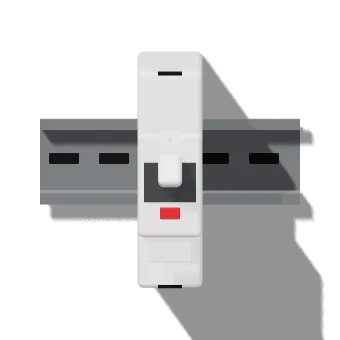
Press its T (Test) button once a month to make sure it works.
Try it: the RCD
4The basic tools
Insulated-handle tools must be marked 1000V with the double-triangle symbol (VDE). Properly insulated tools are not the same as tools that just have rubber grips.
Pliers
For gripping, twisting wire and cutting thin wire.
Side cutters
Cut wires cleanly. Never cut a live wire with them!
Insulated screwdrivers
Flat and Phillips, insulated almost to the tip.
Insulating tape
For insulating joints. Better still, use connectors and wrap tape over them.
Tester screwdriver
Tells you in a second whether a wire is live.
Multimeter (AVO)
Measures volts, ohms and continuity. Your most important instrument (lesson 8).
Clamp meter
Measures current without disconnecting a wire (lesson 9).
Wire strippers
Strip the insulation without nicking the copper.
5Do or don’t?
For each sentence, say whether it is the right thing to do or a mistake you shouldn’t make. You need 6 out of 8 right.
?Lesson questions
An RCD for additional protection of people is 30mA according to IEC 60364 and IEC 61008. Insulated tools follow IEC 60900 (1000V). Your progress is saved on this device only.
© 2026 LearnElectricals. All rights reserved. This site is not affiliated with any of the companies mentioned (such as Siemens, Allen-Bradley, Delta, Schneider and others). Names and trademarks belong to their owners and are used only to identify the devices being taught.