
Course · complete beginners
Electrical Basics for Beginners
From “what is a volt?” to holding a multimeter, wiring a lamp and a socket, and finding the fault yourself.
The first two lessons and lesson 7 are free, no account needed
The lessons are in Arabic for now; the English version is on the way. Device screens and codes are the same as on the real hardware.
The course in numbers
13lessons in order, each building on the last
50+experiments, exercises and self-checking questions
1final exam and a certificate with a verification code
0experience needed before you start
Electrical basics
What you'll learn
- Voltage, current, resistance and power, with simple analogies
- Series vs parallel, and why a house is wired in parallel
- Work out energy use and the electricity bill in kWh
- AC vs DC, single phase vs three phase, and wire colours
- Use a multimeter safely: volts, ohms, continuity and current
- Test a heater, motor, fuse and transformer, good or bad
- Choose the right cable size and breaker for a load
- Wire a switched lamp, an earthed socket and a two-way switch
Contents
The lessons
In order. Every lesson has a short explanation, hands-on experiments and questions.
- What is electricity?FreeVoltage, current, resistance and power with the water analogy, and how the bill is calculated
- Voltage and currentFreeVolts push, amps flow: the closed circuit, current direction, units and how to measure them
- Conductors and insulatorsCopper, aluminium, plastic and water: what conducts, and how wire length and thickness matter
- Series and parallelLamps in a row and side by side, current and voltage in each, why homes use parallel, and batteries
- Power and energyWatts, kilowatts and horsepower, kWh and the home bill, heat in the wire, and efficiency
- Types of electricityDC and AC, single phase and three phase, wire colours and earthing
- Safety and toolsFreeThe voltage tester screwdriver, the RCD and the tools you should carry
- The multimeterMeasure volts, ohms, continuity and current without getting hurt or blowing the meter
- Measuring appliancesHeater, kettle, lamp, fuse and motor, and current with a clamp meter
- Transformers and power suppliesHow a transformer steps voltage down, how a power supply turns AC into DC, and how to test them
- Ohm's law, cables and breakersWork out current from power, and choose the breaker and cable size correctly
- Wiring a lamp and socketWire it yourself: a switched lamp, an earthed socket, a two-way switch, two lamps in parallel
- Common home faultsA game where you find the fault with a tester and multimeter, plus the final exam
Who it's for
Who this course is for
- You're completely new to electricity and don't know where to start
- Technical school and first-year engineering students
- You want to fix things at home yourself, safely
- Before you take the classic control or instrumentation course
FAQ
Before you ask
Do I need to know anything first?
Nothing at all. The course starts from zero and explains every word with everyday analogies before any numbers.
Do I need a multimeter or tools?
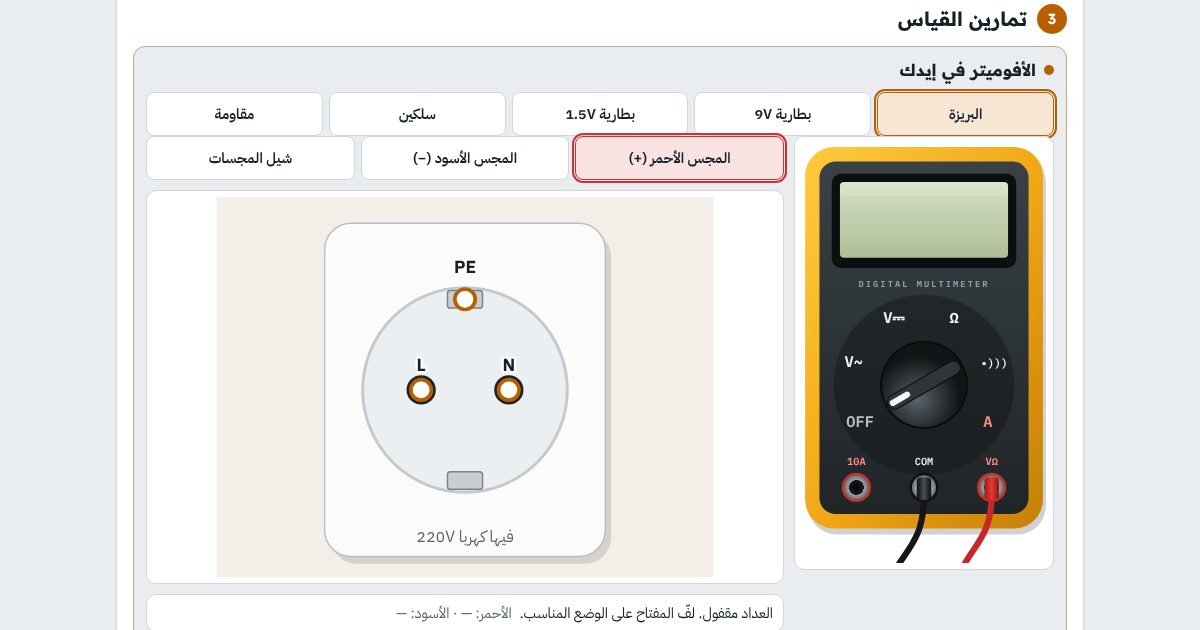
No. The multimeter, boards and devices are all interactive in the page. If you have a real multimeter, you can repeat the same steps on it afterwards.
Is there a certificate?
Yes. When you finish every lesson and the final exam while signed in, you can get a Course Completion Certificate with a verification code and QR code. It confirms you completed the course; it is not an accredited qualification.
Is the course free?
The first two lessons and lesson 7 are open to everyone, no account needed. The other lessons need a free account you can create in seconds with your email.
Can I study on my phone?
Yes. The course works on phones, tablets and computers, and your progress is saved to your account so it follows you to any device.
Ready to start the basics?
The first two lessons and lesson 7 are free, no account needed. Start now and continue at your own pace; your progress is saved.