
Course · control circuits and motors
Classic Control course
Wire contactor and motor circuits by hand, wire by wire, and the course tells you whether it's right, and why.
The first two lessons and lesson 5 are free, no account needed
The lessons are in Arabic for now; the English version is on the way. Device screens and codes are the same as on the real hardware.
The course in numbers
9lessons, from simple devices to star/delta and soft starters
24practical exercises you wire and the course checks
1completion certificate with a verification code
IECIEC and NEMA symbols next to the real device
Classic control
What you'll learn
- Know every panel device: push buttons, selectors, E-stops, limit switches, lamps
- Understand auxiliary relays, seal-in and interlocks
- Wire the power and control circuits of a DOL motor starter
- Choose protection properly: fuses, MCBs, overloads and MPCBs
- Use on-delay, off-delay and cyclic timers in real circuits
- Read a 3-phase motor nameplate and wire the terminal box in star or delta
- Reverse a motor with interlocks, and build sequences and jogging
- Wire automatic star/delta, braking methods and soft starters
Contents
The lessons
In order. Every lesson has a short explanation, hands-on experiments and questions.
- Simple control devicesFreeSwitch, selector, push button, E-stop, limit switch, lamp and supply
- Auxiliary relays and seal-inFreeCoil and changeover contacts, 8/11/14-pin relays and sockets, latching, and interlocks
- The contactorPower and auxiliary contacts, AC-1/AC-3, power and control circuits, and DOL with seal-in
- Protection: fuses, breakers, overloadsFuse types, MCB curves B/C/D, the thermal overload (Ir, class 10, 95-96 and 97-98, phase loss), MPCBs, and protecting a DOL circuit
- TimersFreeOn-delay, off-delay, cyclic and multi-function timers, and timer circuits: sequences, loops, the cart and the pump (practicals 14–24)
- The 3-phase induction motorConstruction and the rotating field, the nameplate, star and delta terminal boxes, direction, power and current tables, cable size
- Pressure, level switches and sensorsPressure switches, float switches, PNP/NPN proximity sensors and photocells, in pump, compressor and conveyor circuits
- Sequences, jogging and reversing (5–13)Conditional starts, sequences, jogging, reversing with interlocks, a hoist with limit switches, and a lathe (practicals 5–13)
- Advanced: star/delta, braking, HVAC, soft startersAutomatic and manual star/delta with a Y-Δ timer, DC and plugging braking and mechanical brakes, a central A/C compressor circuit on 24 V, and soft starters with bypass
Who it's for
Who this course is for
- Technicians and electricians who want to understand the panel, not just copy it
- Technical school and electrical engineering students
- You have a plant or maintenance job interview coming up
- Before you start on VFDs and PLCs
FAQ
Before you ask
Do I need a background first?
It helps to know voltage, current, series and parallel. If not, take the electrical basics course first and come back.
How does the wiring work?
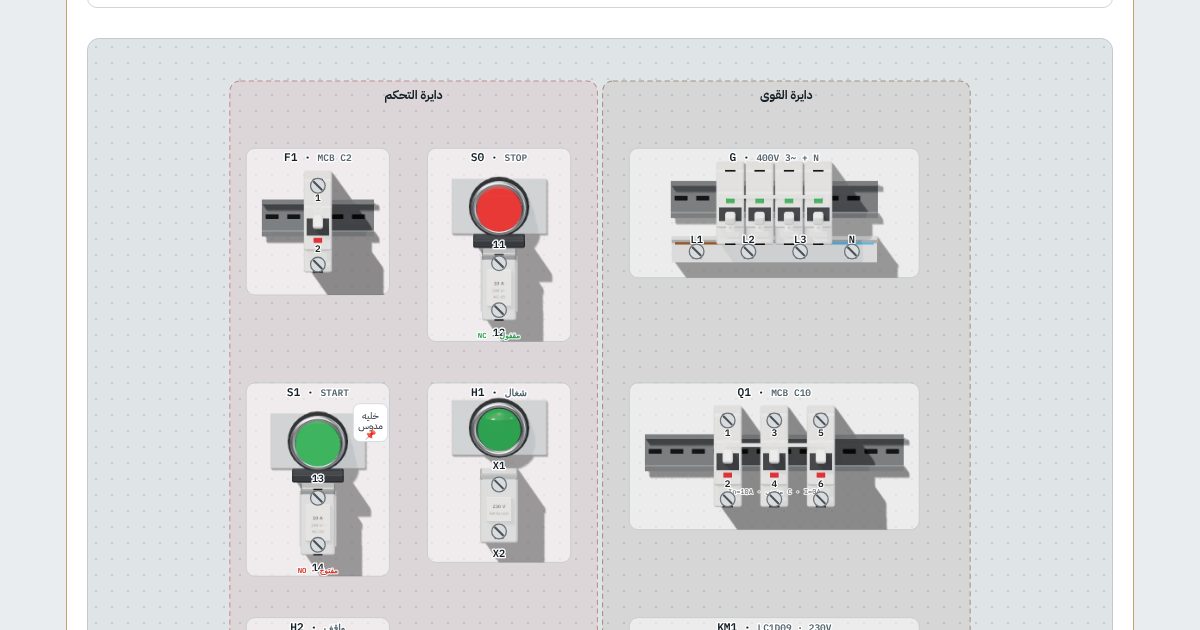
You drag a wire from terminal to terminal on a board like a real panel, then switch on. If something's wrong, the course shows where and why.
Is there a certificate?
Yes. When you finish every lesson and the final exam while signed in, you can get a Course Completion Certificate with a verification code and QR code. It confirms you completed the course; it is not an accredited qualification.
Is the course free?
The first two lessons and lesson 5 are open to everyone, no account needed. The other lessons need a free account you can create in seconds with your email.
Does it work on a phone?
Yes. The board fits small screens, but wiring is more comfortable on a tablet or computer.
Ready to start classic control?
The first two lessons and lesson 5 are free, no account needed. Start now and continue at your own pace; your progress is saved.