
Course · electrical drawings
Reading Electrical Drawings course
Read and understand any panel drawing, and trace a fault from it with a multimeter, even on a panel you've never seen.
The first two lessons and lesson 4 are free, no account needed
The lessons are in Arabic for now; the English version is on the way. Device screens and codes are the same as on the real hardware.
The course in numbers
7lessons, from symbols to fault tracing
2symbol standards side by side: IEC and ANSI/NEMA
1final exam and a completion certificate
22exercises, experiments and self-checking questions
Electrical drawings
What you'll learn
- Know the drawing types and which one answers which question
- Read IEC and ANSI/NEMA symbols for contacts, coils and protection
- Understand device tags like -K1 and -Q1 and terminals like 13-14 and 95-96
- Jump with cross-references from a coil to its contacts
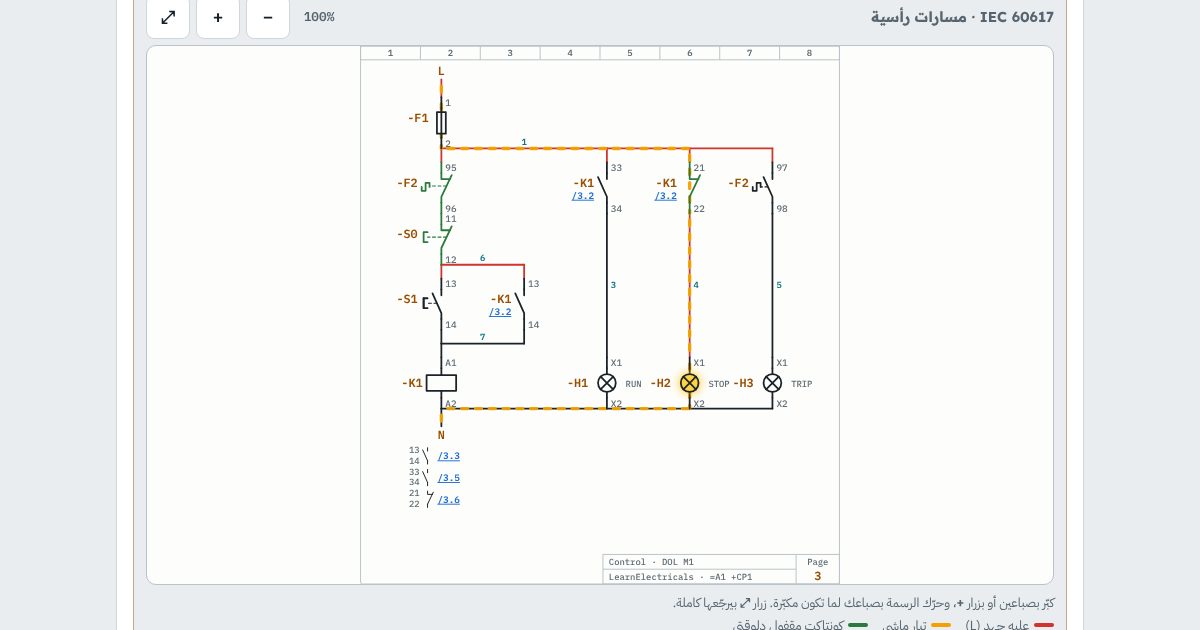
- Read a DOL circuit and a reversing circuit step by step
- Read a single line diagram from transformer to motor, with ratings and cable sizes
- Follow a wire from the sensor to the terminal strip to the PLC on the panel layout
- Find the fault from the drawing: symptom, then test point, then fault
Contents
The lessons
In order. Every lesson has a short explanation, hands-on experiments and questions.
- Types of electrical drawingsFreeSingle line, power, control, wiring, terminal, panel layout, P&ID and cable schedule: each one answers a question
- Symbols: IEC and ANSI/NEMAFreeNO and NC contacts, coils, buttons, selectors, limit switches, timers, overloads, breakers, fuses, motors, transformers, lamps and sensors
- Device tags, terminals and cross-referencesTags -K1, -Q1 and -F1, terminals 13-14, 21-22, A1-A2 and 95-96, wire numbers, and references like /3.4
- Reading a control circuitFreeStep by step through a DOL circuit and a reversing circuit, following the current as you press the buttons
- Single line and power circuitsFrom transformer to MDB to breakers to MCC to motor: ratings and cable sizes on the drawing
- Panel layout and terminal stripsDIN rail, trunking and devices, terminal strips X1 and X2, cable cores and ferrules, and tracing a wire from sensor to PLC
- Fault tracing from the drawing + final examSymptom → drawing → test point → fault, the fault game, and the final exam
Who it's for
Who this course is for
- Electrical and maintenance technicians in plants and buildings
- Electrical, mechatronics and technical-school students
- You receive panels or do commissioning
- You fix faults and need to reach the cause faster
FAQ
Before you ask
Do I need a background first?
You should understand voltage and current, be able to use a multimeter, and know how contactors and relays work. If not, start with the basics and classic control courses.
IEC or American symbols?
Both, side by side: the IEC symbols used in most panels, and the ANSI/NEMA symbols on American equipment and drawings.
Is there a certificate?
Yes. When you finish every lesson and the final exam while signed in, you can get a Course Completion Certificate with a verification code and QR code. It confirms you completed the course; it is not an accredited qualification.
Is the course free?
The first two lessons and lesson 4 are open to everyone, no account needed. The other lessons need a free account you can create in seconds with your email.
Does it work on a phone?
Yes. Drawings zoom and pan with your finger, though a bigger screen is more comfortable.
Ready to learn to read drawings?
The first two lessons and lesson 4 are free, no account needed. Start now and continue at your own pace; your progress is saved.