
Course · sensors and signals
Instrumentation course
Understand the sensors and signals in every plant, then wire them, calibrate them and troubleshoot them like a field technician.
The first two lessons and lesson 5 are free, no account needed
The lessons are in Arabic for now; the English version is on the way. Device screens and codes are the same as on the real hardware.
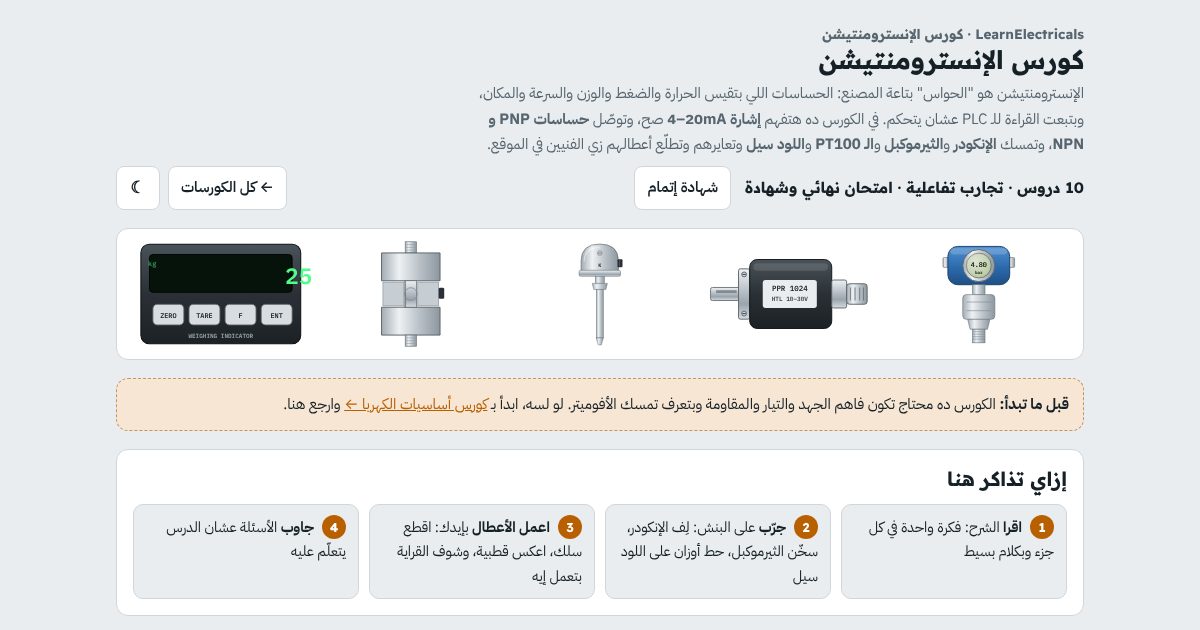
The course in numbers
10lessons, from the loop to calibration
4–20mA: the signal you'll meet everywhere
1final exam and a completion certificate
30+experiments, exercises and self-checking questions
Instrumentation
What you'll learn
- Read loops and tags: TT, PT and FT, PV, SP and range
- Convert 4–20 mA to a real value, and know why it starts at 4
- Wire 2-, 3- and 4-wire transmitters correctly
- Tell PNP from NPN and wire them to a PLC input card
- Understand incremental and absolute encoders and their faults
- Choose and wire thermocouples and PT100, and spot wiring errors
- Calibrate a scale and diagnose a load cell with a multimeter
- Do a loop check and an as-found / as-left sheet
Contents
The lessons
In order. Every lesson has a short explanation, hands-on experiments and questions.
- What is instrumentation?FreeThe loop: sensor, transmitter, controller and valve. PV, SP and range, and reading tags like TT-101
- Analog signals: 4–20 mA and 0–10 VFreeWhy 4 and not zero, 2-, 3- and 4-wire transmitters, scaling to a value, and measuring loop current
- Digital sensorsProximity, photocell and limit switches, NO/NC, and PNP and NPN with a PLC input card
- Encoders 1: incrementalThe disc and channels A, B and Z, direction, PPR, x1/x2/x4 counting, speed and output types
- Encoders 2: absolute, mounting and faultsFreeGray code, single and multi-turn, SSI and PROFINET, mounting and shielding, and the fault game
- Temperature 1: thermocouplesTypes K, J, T and S, cold-junction compensation, extension cable, colours and faults
- Temperature 2: PT100, RTD and NTC100 Ω at 0 °C, 2-, 3- and 4-wire and lead error, transmitters, NTC and PTC
- Load cells and scalesStrain gauges and the bridge, mV/V, 4- and 6-wire, scale calibration, and diagnosing a load cell with a multimeter
- Pressure, level and flowPressure and DP transmitters, level by pressure and radar, and magnetic, vortex and Coriolis flowmeters
- Calibration and troubleshooting + final examLoop check, as-found / as-left, the calibrator, the field fault game, and the final exam
Who it's for
Who this course is for
- Maintenance and instrument technicians in plants
- Electrical, mechatronics and control engineering students
- Electricians moving into instrumentation
- You work with PLCs and need to understand the signals coming in
FAQ
Before you ask
Do I need a background first?
You should understand voltage, current and resistance and be able to use a multimeter. If not, start with the electrical basics course.
Is it about a specific brand?
No. The course explains the ideas that are the same across brands, with examples from devices common on the market.
Is there a certificate?
Yes. When you finish every lesson and the final exam while signed in, you can get a Course Completion Certificate with a verification code and QR code. It confirms you completed the course; it is not an accredited qualification.
Is the course free?
The first two lessons and lesson 5 are open to everyone, no account needed. The other lessons need a free account you can create in seconds with your email.
Does it work on a phone?
Yes. Every bench and experiment works on phones, tablets and computers.
Ready to start instrumentation?
The first two lessons and lesson 5 are free, no account needed. Start now and continue at your own pace; your progress is saved.