
Motor & transformer maintenance
How to test a motor and a transformer with real instruments, read the result and decide: keep it running, watch it, or repair it. You start with safety, lockout and test instruments, then the megger and PI, winding resistance, bearings, vibration and laser alignment, then transformer inspection, electrical tests, oil and gas analysis. Built on IEEE 43, IEC 60034, ISO 20816, IEC 60076 and IEC 60599, with a maintenance plan for one factory's motors and transformer as the project.
The first lesson is free; both simulators open with the course
The lessons are in Arabic for now; the English version is on the way. Symbols, units and standards are the same as in the real documents.
12 lessons in order, each followed by a simulator exercise
Every test is worked through step by step with real numbers. Every lesson has a quiz; the last one has the project and the final exam.
- Electrical maintenance: types, safety and test instrumentsFree
- QuizLesson questions
- The induction motor: construction, nameplate and terminals
- QuizLesson questions
- Insulation resistance testing: megger, PI and DAR
- QuizLesson questions
- Winding tests: resistance, balance and shorts
- QuizLesson questions
- Bearings and lubrication
- QuizLesson questions
- Vibration and alignment
- QuizLesson questions
- Heat and current: overload and voltage unbalance
- QuizLesson questions
- Motor troubleshooting step by step
- QuizLesson questions
- The transformer: construction, accessories and routine inspection
- QuizLesson questions
- Transformer electrical tests
- QuizLesson questions
- Transformer oil: breakdown voltage and dissolved gas analysis
- QuizLesson questions
- Project: a factory maintenance plan + the final exam
- QuizLesson questions
- ExamFinal exam
The course in numbers
What you'll learn
- Tell preventive, predictive and corrective maintenance apart, apply isolation and LOTO before any work, and pick the right test instrument
- Read a motor nameplate, work out its current, slip and torque, and identify the winding terminals and the star and delta connections
- Test insulation with a megger, correct the reading to 40 °C, and work out the polarization index and DAR to IEEE 43
- Measure winding resistance and its unbalance, and find shorted turns, ground faults and open phases
- Work out the regreasing interval and quantity, diagnose a bearing by its sound and temperature, and know why bearings fail
- Measure vibration to ISO 20816, find unbalance and soft foot, and align shafts with a laser tool
- Read a thermal image, work out the derating for voltage unbalance, and analyse the motor current
- Troubleshoot motor faults methodically, and decide between repair and rewinding
- Inspect a transformer and its accessories: the Buchholz relay, the silica gel breather and the temperature gauges, and run the TTR, winding and insulation tests
- Test the oil breakdown voltage, interpret dissolved gas analysis on the Duval triangle, and build a maintenance plan for a factory
Motor maintenance workshop and transformer maintenance station: 11 exercises
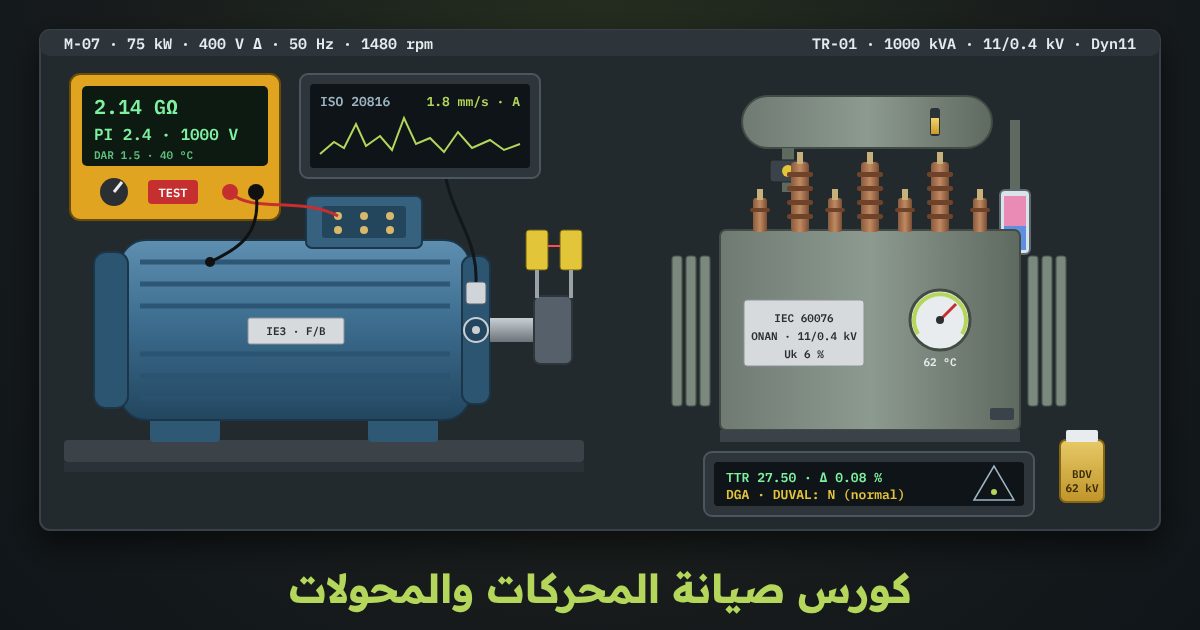
A real motor on the test bench, measured with the same instruments you use on site, and a 1000 kVA distribution transformer to inspect, test and sample. Each exercise belongs to a lesson and counts toward your progress.
- Motor nameplateRead the nameplate of a real motor, work out its current, slip and torque, then connect it in star or delta to suit the supply
- Megger insulation testChoose the test voltage, measure the insulation resistance and correct it to 40 °C, work out the polarization index and DAR, then judge the motor to IEEE 43
- Winding resistanceMeasure the three windings with a micro-ohmmeter, work out the unbalance, and find shorted turns, a ground fault or an open phase
- Bearings and greasingWork out the regreasing interval and quantity, listen to the bearing and measure its temperature, then find the cause of the damage
- Vibration and laser alignmentMeasure vibration against the ISO 20816 limits, check for soft foot, then align the shafts with a laser tool until they are within tolerance
- Heat and voltage unbalanceRead a thermal image, work out the voltage unbalance and the derating it needs, and analyse the motor current
- TroubleshootingMotors with real faults: won't start, runs hot, vibrates or trips. Find the cause methodically, and decide between repair and rewinding
- Transformer inspection roundCheck the oil level, temperature gauges, Buchholz relay, silica gel breather and leaks, and log what you find
- Transformer electrical testsTest the turns ratio (TTR), winding resistance, insulation and PI, and verify the vector group
- Transformer oil and gas analysisTest the oil breakdown voltage, plot the dissolved gas analysis on the Duval triangle, and decide whether to treat or replace the oil
- Factory maintenance planBuild a maintenance plan for the factory's motors and transformer: the tasks, intervals, readings and decisions
Who this course is for
- Electrical maintenance engineers and technicians in plants, water stations and buildings
- Anyone who receives new or repaired motors and transformers and wants to know what to measure and how to judge the result
- Rewinding-shop technicians who want to understand the tests before and after a rewind
- After the electrical basics and classic control courses; every test is worked through with numbers
Before you ask
Do I need real test instruments?
Which standards does it cover?
Do I need an account?
Is there a certificate?
Ready to test your first motor?
The first lesson is free; the whole course with both simulators opens when you buy it. Start now and continue at your own pace; your progress is saved.