
Course · 16 lessons · 16 workshop exercisesHands-on maintenance
Practical machine mechanics course
The mechanical maintenance a fitter does by hand. Each idea is one line and a picture, and every lesson has an exercise on a real machine: tighten a flange in a star pattern, shim a motor into alignment, read a micrometer, fit a bearing with a heater, tension a belt and grease with the calculated amount.
Lesson 1 is open to everyone
Contents
16 lessons in order, a workshop exercise in each
Each lesson is one idea per line with a picture you get at a glance, then a 3-round exercise and short questions. The last lesson is fault finding and a final exam.
- Inside the machine: the drive trainFree for all
- From motor to load
- Each part and its job
- Speed falls… torque rises
- 4 things that ruin any machine
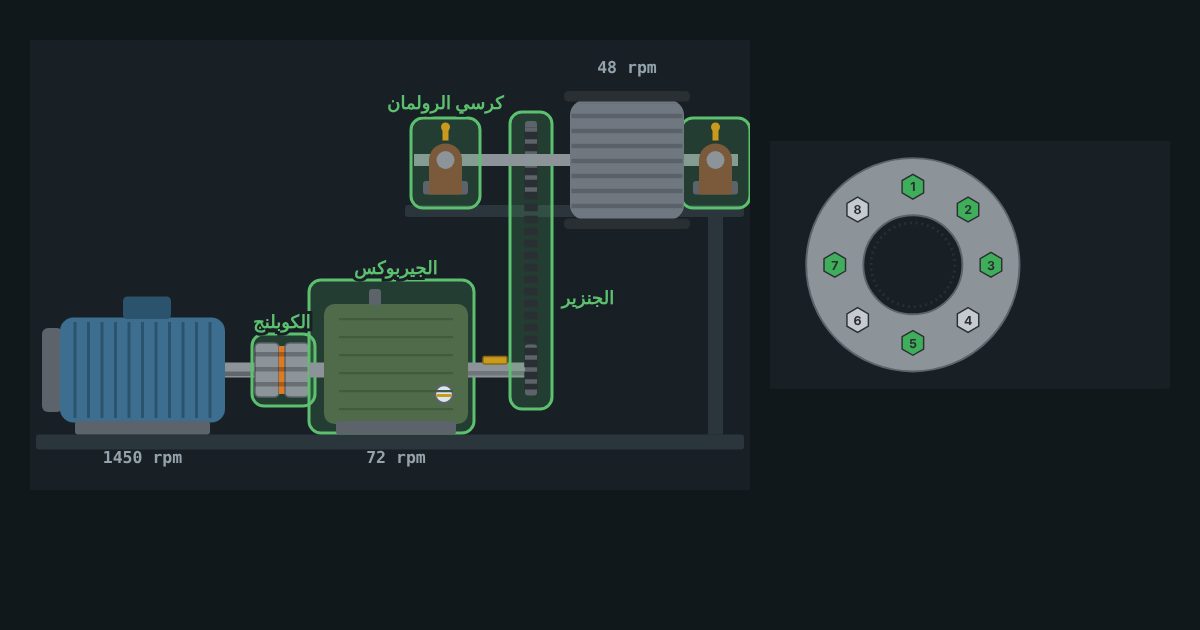
- ExerciseThe conveyor drive: know every part
- QuestionsLesson questions
- Bolts and nuts
- Read the size: M12 × 1.75
- Strength: the number on the head
- The right spanner
- How to stop a bolt working loose
- ExercisePick the bolt and spanner
- QuestionsLesson questions
- Tightening torque and sequence
- Why torque matters
- Torque table (steel 8.8, dry thread)
- The torque wrench
- Star pattern, in stages
- ExerciseAn 8-bolt flange
- QuestionsLesson questions
- Keys, bushes and fixing parts on a shaft
- Two jobs, two fixes
- Key size from shaft diameter
- The taper-lock bush
- Stopping it sliding
- ExerciseMount the pulley on the shaft
- QuestionsLesson questions
- Couplings
- Rigid or flexible?
- Types you will meet
- How to choose
- Signs of a tired coupling
- ExerciseChoose the right coupling
- QuestionsLesson questions
- Shaft alignment
- Two kinds of error
- Measuring tools
- First: soft foot
- Acceptable limits (around 1500 rpm)
- ExerciseAligning a motor to a gearbox
- QuestionsLesson questions
- Reading a micrometer
- Parts of the micrometer
- The linear scale (on the sleeve)
- The circular scale (on the thimble)
- Reading in 3 steps
- ExerciseThe micrometer, close up
- QuestionsLesson questions
- Bearings: types and numbers
- Types and their jobs
- Decoding 6205-2RS C3
- The letters after the number
- ExerciseDecode the bearing number
- QuestionsLesson questions
- Removing and fitting bearings
- The golden rule
- Fitting with a heater
- Removal
- Mistakes that kill it early
- ExercisePut the job steps in order
- QuestionsLesson questions
- O-rings and seals: stopping leaks
- The O-ring: just two sizes
- Material by fluid and temperature
- The oil seal: lip towards the oil
- Fitting without damage
- ExerciseChoose the material, fit the seal
- QuestionsLesson questions
- Gears, gear types and ratio
- The types
- Ratio from the teeth
- The module must match
- The worm: big ratio and self-locking
- ExerciseTwo gears on two shafts
- QuestionsLesson questions
- The gearbox: choosing it and its oil
- The nameplate
- Service factor
- The oil
- Daily checks
- ExercisePick the gearbox, watch its oil
- QuestionsLesson questions
- Belts and pulleys
- V-belt sections
- Ratio from the diameters
- Tension by deflection
- Fitting and alignment
- ExerciseBelt tension by deflection
- QuestionsLesson questions
- Chains and sprockets
- The pitch
- The links
- Slack and stretch
- Lubrication
- ExerciseMeasure the chain and decide
- QuestionsLesson questions
- Greasing and oiling
- Grease or oil?
- The numbers on the tub
- The right amount
- How to grease correctly
- ExerciseThe grease gun
- QuestionsLesson questions
- Fault finding + final exam
- Your tools
- Sign → cause
- Temperature
- The inspection plan
- ExerciseDiagnose the faulty machine
- QuestionsLesson questions
- QuestionsFinal exam (21 questions)
The course in numbers
16lessons from the bolt to fault finding
16workshop exercises, 3 rounds each
117questions in the lessons and final exam
80%to pass and earn a certificate
Mechanical maintenance
What you will learn
- Read a bolt’s size and grade and tighten it to the right torque in a star pattern
- Choose the right key and coupling, align with shims and fix soft foot
- Read a micrometer on its sleeve and thimble scales to 0.01 mm
- Read a bearing number, fit it with a heater without damage, and choose the right O-ring and seal
- Work out gear ratios, size a gearbox with a service factor and watch its oil
- Tension a belt by deflection, measure chain stretch and grease the calculated amount
- Tell a fault from its noise, heat, vibration or leak
Who it is for
Who this course is for
- Electrical maintenance technicians who work next to fitters and want to understand their work
- Beginners in factory mechanical maintenance
- Technical diploma and engineering students as a practical start
- Want the physics behind torque and gears? Mechanics basics complements this course
FAQ
Before you ask
Do I need experience first?
No. The course starts from the machine parts themselves and every number comes with an example.
Do the exercises work on a phone?
Yes. Every exercise is taps and sliders, designed for phones first.
Can I use these numbers on the job?
They are rounded for learning and give you the right feel. On the job always follow the maker’s catalogue.
Is there a certificate?
Yes, a certificate of completion when you finish every lesson and pass the final exam.
Ready to tighten your first flange?
Lesson 1 is open to everyone, and the whole course opens when you buy it. Your progress is saved.