
Electrical panel design
How to calculate a factory's loads, pick the right breaker, cable and busbar, check voltage drop, short circuit, selectivity and earthing, then lay out the panel, work out its heat rise and hand it over tested. Built on IEC 60364, IEC 61439, IEC 60947 and the Egyptian code, with a main distribution board project from the transformer to the last feeder.
The first lesson is free; both simulators open with the course
The lessons are in Arabic for now; the English version is on the way. Symbols, units and standards are the same as in the real documents.
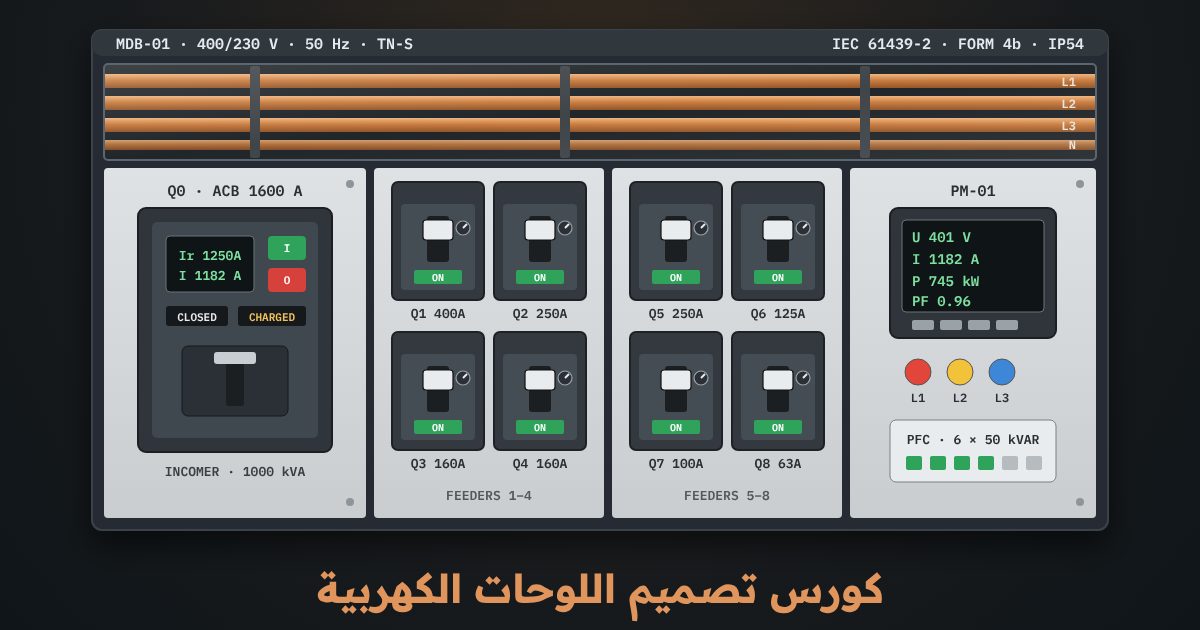
12 lessons in order, each followed by a simulator exercise
Every calculation is worked through step by step with real numbers. Every lesson has a quiz; the last one has the project and the final exam.
- What is an electrical panel? Types and standardsFree
- QuizLesson questions
- Load calculation and design current
- QuizLesson questions
- Selecting circuit breakers
- QuizLesson questions
- Sizing the cable
- QuizLesson questions
- Voltage drop and short-circuit current
- QuizLesson questions
- Copper busbars
- QuizLesson questions
- Coordination and selectivity between protective devices
- QuizLesson questions
- Earthing and protection against electric shock
- QuizLesson questions
- Power factor correction
- QuizLesson questions
- Panel layout and the heat inside it
- QuizLesson questions
- Motor control centres (MCC)
- QuizLesson questions
- Project: a main distribution board + the tests and the exam
- QuizLesson questions
- ExamFinal exam
The course in numbers
What you'll learn
- Tell main and sub-distribution boards, motor control centres, PFC panels and transfer panels apart, and know what IEC 61439 asks for
- Calculate loads with demand and diversity factors, and work out the design current Ib for every feeder and the whole board
- Pick the right MCB, MCCB or ACB, set Ir, Isd and Ii, and check the breaking capacities Icu and Ics
- Size cables with the correction factors and the Ib ≤ In ≤ Iz rule
- Work out voltage drop and short-circuit current at every point, and check the cable's thermal withstand
- Design copper busbars and the earth and neutral bars, and work out the short-circuit forces on the supports
- Make protective devices selective on time-current curves, and use cascading correctly
- Choose the TN, TT or IT earthing system, the PE conductor size and the RCDs
- Size a capacitor bank in kVAR, with its steps and its protection
- Lay out the panel, choose the form of separation and the IP rating, work out the heat rise, and design MCC feeders to Type 2 coordination
Panel designer's calculator and electrical panel designer: 11 exercises
A single-line diagram of a whole factory to calculate on, and a designer where you lay out the panel at real sizes. Each exercise belongs to a lesson and counts toward your progress.
- Load calculationA small factory: add up the installed power, apply the demand and diversity factors, and work out the design current Ib for every feeder and for the whole board
- Selecting breakersPick an MCB, MCCB or ACB for every feeder, set Ir, Isd and Ii, and check that the breaking capacity Icu is above the short-circuit current at the board
- Cable sizingApply the temperature, grouping and installation-method factors, and pick the smallest size that meets Ib ≤ In ≤ Iz
- Voltage drop and short circuitWork out the voltage drop to the last load and the short-circuit current at every board, and upsize the cable when the drop is over the limit or it fails k²S² ≥ I²t
- Copper busbarsSize the busbar for current and temperature, and check the short-circuit forces, the support spacing and the earth and neutral bars
- SelectivityMove the breaker curves on the time-current chart until only the breaker closest to the fault trips
- Earthing and shock protectionChoose the earthing system, the PE conductor size and the right RCD, and check that the disconnection time is within the limit
- Capacitor bankWork out the kVAR needed to correct the power factor, split it into steps, and choose the detuning reactors and the bank protection
- Panel layout and heatChoose the enclosure, place the components at their real sizes with the form of separation and the IP rating, and work out the temperature rise and ventilation
- MCC feedersDesign DOL, star-delta, soft-starter and VFD feeders to Type 2 coordination, and pick the breaker, contactor and overload for each one
- Main distribution board projectDesign the factory's main distribution board from the calculation to the layout, and hand it over after the acceptance tests
Who this course is for
- Electrical engineers who design or check distribution boards and motor control centres
- Panel builders and supervisors who want to understand the calculation behind every choice
- Maintenance engineers and technicians who want to know why a breaker trips and when a cable overheats
- After the electrical basics and classic control courses; every calculation is worked through with numbers
Before you ask
Do I need design software or catalogues?
Which standards does it cover?
Do I need an account?
Is there a certificate?
Ready to design your first panel?
The first lesson is free; the whole course with both simulators opens when you buy it. Start now and continue at your own pace; your progress is saved.